Written by: Editorial Research Team (Research & Fact-Checking Desk)
Reviewed by: Editorial Review Panel (Source Verification Desk)
Editorial Standard: Fact-Checked Reference Guide | Primary Source Verified — Cross-checked against primary documentation, public filings & published industry standards
Editorial Verification Standard: Technical parameters, comparative benchmarks, and procedural steps are cross-checked against primary documentation and published standards.
Urban third places are regular settings outside home and formal work where people can enter, remain, and encounter others. Libraries, parks, cafés, markets, community centers, plazas, and some religious or cultural venues can serve this role.
Repetition matters. Familiarity grows through ordinary contact: seeing the same staff, recognizing neighbors, exchanging small favors, or learning where local help is available. These encounters may support weak ties, but outcomes depend on affordability, safety, accessibility, governance, and local culture.
Research does not establish one universal third-place formula. A cross-sectional study of 608 adults in Galway, Ireland, associated walkable neighborhoods and neighborhood social capital with more social contacts and stronger neighborhood trust. The study did not prove that walkability caused those outcomes. A qualitative study of East London public spaces identified sociability, familiarity, weak-tie interaction, and informal support as recurring features of everyday use; it did not estimate population-wide effects. Holt-Lunstad and colleagues’ review of social relationships and mortality risk found an association between stronger social relationships and a 50% greater likelihood of survival across 148 studies. That finding concerns social relationships broadly, not attendance at third places.
The U.S. Surgeon General identifies social connection as a public-health concern and recommends stronger community institutions and opportunities for interaction. The WHO’s community-level social-connection priority likewise calls for environments that enable meaningful connection. Neither source proves that a specific plaza, café, or library will produce a defined health outcome.
What makes a third place useful?
Ray Oldenburg’s account emphasized accessible, informal settings separate from home and work. His framework remains influential, but it has limits. Critics note that the original model underplayed gender, race, class, disability, commercial dependence, and cultural differences. A place that feels neutral to one group may feel surveilled, unsafe, unaffordable, or exclusionary to another.
Practical questions matter more than labels:
- Can people reach the place without high transport, purchase, or membership costs?
- Can they stay without pressure to spend?
- Are hours predictable?
- Can disabled people use routes, seating, toilets, acoustics, and signage?
- Do rules protect people without targeting poverty, youth, migration status, or disability?
- Can different groups use the space without one group controlling it?
- Do residents have meaningful influence over programming and rules?
Project for Public Spaces’ placemaking guidance emphasizes access and linkages, comfort and image, uses and activities, and sociability. Those categories offer practitioner guidance, not a validated outcome standard. A site may satisfy them and still fail through poor management, exclusion, displacement, or unaffordable use.
What research supports
Evidence falls into three categories.
Observed association. Leyden linked walkability with reported social contacts and neighborhood trust. The design was cross-sectional. It cannot separate built-environment effects from self-selection, income, prior relationships, or other factors.
Qualitative mechanism. Cattell and colleagues described how lingering, recognition, casual conversation, and informal support can develop in everyday public spaces. Such findings help explain possible pathways. They do not establish effect size or causation.
Public-health priority. The Surgeon General and WHO identify social connection as important and recommend community-level action. Their recommendations support investment and evaluation; they do not validate a fixed third-place protocol.
Klinenberg’s Palaces for the People uses the term “social infrastructure” for physical settings that shape interaction. This is a conceptual and comparative framework. Municipal programs still need local evidence.
Digital communities can extend access for people separated by distance, illness, caregiving, mobility limits, or language. They can support coordination and continuity. They do not reproduce every feature of shared physical space, including local visibility, embodied presence, and unplanned encounters. Digital and physical options should complement each other, not compete as universal substitutes.
Planning guidance
Protect ordinary places
Cities should first assess existing libraries, parks, markets, community rooms, cafés, faith venues, and privately owned public spaces. A modest place with regular users may provide more continuity than a new destination designed around occasional events.
Review:
- opening hours and seasonal availability;
- walking, transit, cycling, and step-free access;
- seating, shade, shelter, toilets, water, lighting, and acoustics;
- minimum purchase, membership, parking, and program fees;
- language access and discoverability;
- staff presence, maintenance, complaints, and safeguarding;
- rules governing rest, photography, commercial activity, and public assembly.
These are planning checks, not universal performance thresholds.
Reduce barriers
Access includes more than entry. A building can meet legal access requirements while remaining difficult to use because of glare, noise, inaccessible furniture, confusing signs, poor staff practice, or unavailable toilets.
Useful interventions may include:
- free seating and water;
- step-free routes and accessible toilets;
- shade, weather protection, and rest points;
- multilingual signs and schedules;
- predictable evening or weekend hours;
- fee waivers or low-cost programs;
- movable furniture;
- clear rules against harassment and discriminatory exclusion;
- privacy-preserving feedback channels.
Each intervention needs local testing. No fixed package guarantees social connection.
Preserve unstructured use
Programming can create entry points, but excessive programming can eliminate quiet and spontaneous use. Residents should be able to read, wait, talk, observe, or rest without joining an activity.
Commercial venues require special care. A café may support recurring contact, yet prices, purchase expectations, turnover rules, and limited seating can exclude people. Public subsidies, reduced-rent leases, free seating, or operating agreements may widen access, but each creates budget and governance obligations.
Consultation alone does not establish inclusion. Residents, venue users, disabled people, youth, older adults, caregivers, staff, and groups facing exclusion should influence rules, programming, and evaluation. Their role should be defined before project launch.
Safety policy should address harassment, medical emergencies, children, fire access, sanitation, and conflict. Enforcement should be proportionate. Surveillance deserves separate review because cameras, facial recognition, and identifiable attendance records can discourage use, especially among people wary of institutions.
Measuring local performance
No single metric captures connection. A practical evaluation can combine:
| Question | Possible evidence | Caution |
|---|---|---|
| Can residents reach and use it? | Travel routes, hours, access audit, price review | Legal access does not equal practical access |
| Do people return? | Anonymous counts, repeated surveys, staff logs | Avoid unnecessary identification |
| Do people feel welcome? | Short surveys, interviews, complaint records | Responses may underrepresent absent users |
| Does use include varied groups? | Voluntary demographic data, outreach records | Protect privacy; do not infer identity |
| Do interactions occur? | Observation, reported recognition, conversation, informal help | Observation cannot prove durable relationships |
| Does the place remain affordable? | Minimum purchase, transport burden, program cost | Include time cost and lost wages |
| Does governance work? | Resident decisions, rule changes, complaint outcomes | Attendance at meetings is not decision power |
Define every measure before collecting it. “Repeat visitor” requires a privacy-preserving method and a stated time period. “Belonging” requires consistent questions. “Diversity” requires voluntary, ethically governed information. Foot traffic alone can reward a large event, a transit route, or commercial turnover while missing quiet, essential use.
Compare results with a baseline when possible. Report missing groups, seasonal effects, staff burden, maintenance costs, and unintended consequences. Treat changes as associations unless the evaluation design supports stronger causal inference.
A restrained implementation sequence
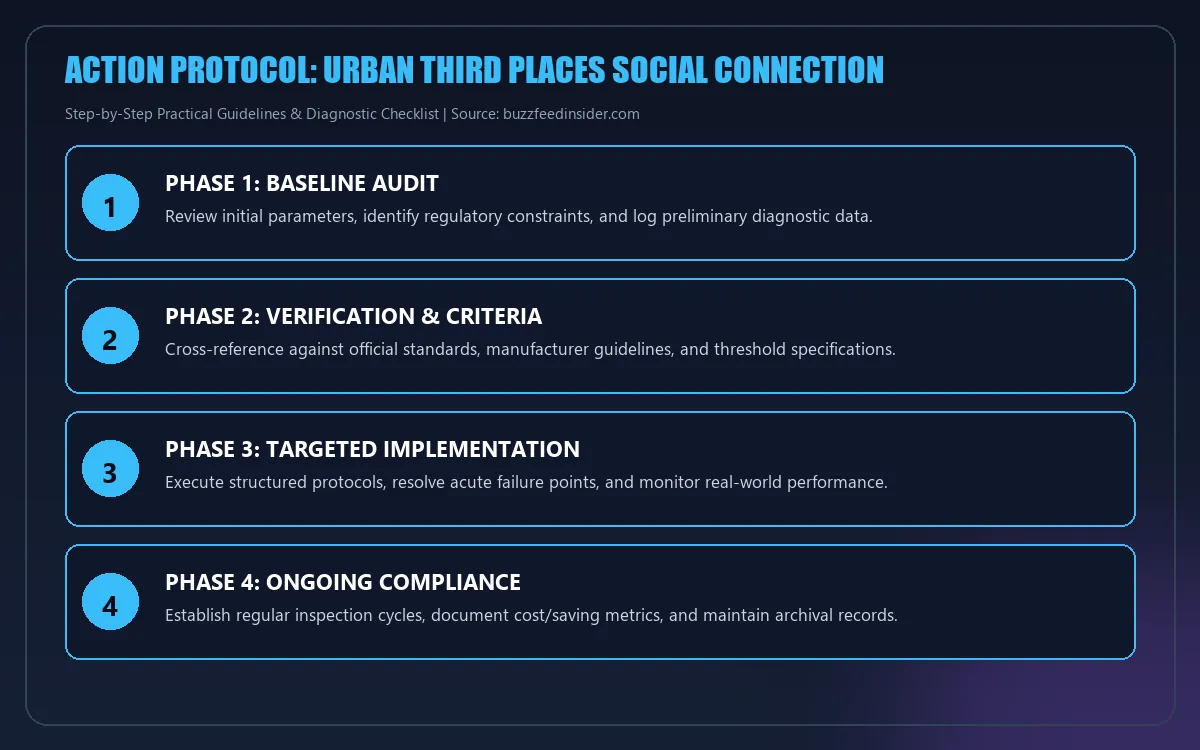
The sequence below is editorial planning guidance, not an evidence-validated protocol. Fixed pilot durations and decision gates should be adapted to budget, season, venue type, and evaluation capacity.
- Map existing supply. Record venues, hours, costs, access features, seating, toilets, shelter, and observed use. Identify areas without nearby free or low-cost options.
- Listen locally. Use paper and online surveys, interviews, walking audits, and accessibility reviews. Recruit people absent from formal meetings.
- Name barriers. Separate price, distance, schedule, language, disability, safety, childcare, cultural fit, and perceived surveillance.
- Choose a limited intervention. Start with an operational change when evidence points to hours, seating, toilets, signage, or staff practice. Pair capital work with operating funds.
- Set rules publicly. Explain access, conduct, recording, pets, smoking, commercial activity, safeguarding, and complaint routes in plain language.
- Collect baseline evidence. Define measures, privacy limits, responsible staff, and reporting dates before launch.
- Review and revise. Check early safety and access problems, then compare later evidence with baseline and resident feedback. Continue, redesign, pause, or scale based on documented results.
- Assign durable responsibility. Name owners for maintenance, programming, safeguarding, evaluation, complaints, and funding.
Common failure patterns
Crowds mistaken for connection. High attendance may reflect a festival or transit route. Check repeat use and reported welcome.
Commercial access mistaken for public access. A privately operated venue may change prices, hours, or rules. Publish access conditions and complaint routes.
Compliance mistaken for usability. A ramp does not resolve inaccessible toilets, poor acoustics, confusing signs, or hostile staff behavior.
Safety mistaken for exclusion. Removing unhoused people, teenagers, vendors, migrants, or disabled people can make a site appear orderly while reducing social range.
Consultation mistaken for governance. Feedback without decision power rarely changes rules or budgets.
Digital access mistaken for local inclusion. Online tools can reduce distance barriers but still require devices, data, skills, privacy, and moderation.
Investment mistaken for benefit. New public-realm spending can raise rents, displace vendors, or market a neighborhood to newcomers. Evaluate distributional effects.
Frequently Asked Questions
What counts as an urban third place?
A third place is a recurring social setting outside home and formal work where people can interact with relatively low pressure. Libraries, parks, markets, cafés, community centers, plazas, and some faith or cultural venues may qualify.
Use depends on access and behavior. A shopping center may function as one if people can sit and meet without constant purchasing. A coworking site may serve members but not the wider public. A stadium can host large gatherings without providing routine, low-cost contact.
Why does repeated use matter?
Repeated use creates recognition and lowers the social risk of interaction. People may learn names, exchange practical information, or become familiar with local norms. Research describes these as plausible mechanisms for weak ties and informal support.
Repetition does not guarantee trust, friendship, or better health. Cost, exclusion, conflict, and surveillance can make repeated attendance burdensome or impossible.
Can online communities replace physical third places?
They can provide support, coordination, and continuity, especially for people facing distance, illness, caregiving, or mobility barriers. They cannot reproduce every feature of shared physical settings, including local visibility, embodied presence, and unplanned contact.
Cities should offer digital information and hybrid participation while preserving accessible physical options.
How should cities judge success?
Use several measures: practical access, affordability, repeat use, perceived welcome, interaction quality, safety, inclusion, maintenance, staff burden, and resident influence over decisions. Combine counts with interviews and accessibility audits.
Do not claim that a single project caused improved health based on foot traffic or short-term surveys. State what was measured, what was not measured, which groups remained absent, and how findings changed the project.
References
- Cattell, V., Dines, N., Gesler, W., & Curtis, S. (2008). “Mingling, Observing, and Lingering: Everyday Public Spaces and Their Implications for Well-being and Social Relations.” Health & Place, 14(3), 544–561. https://doi.org/10.1016/j.healthplace.2007.10.005
- Holt-Lunstad, J., Smith, T. B., & Layton, J. B. (2010). “Social Relationships and Mortality Risk: A Meta-analytic Review.” PLOS Medicine, 7(7), e1000316. https://doi.org/10.1371/journal.pmed.1000316
- Klinenberg, E. (2018). Palaces for the People: How Social Infrastructure Can Help Fight Inequality, Polarization, and the Decline of Civic Life. Crown.
- Leyden, K. M. (2003). “Social Capital and the Built Environment: The Importance of Walkable Neighborhoods.” American Journal of Public Health, 93(9), 1546–1551. https://pubmed.ncbi.nlm.nih.gov/12948970/
- Oldenburg, R. (1999). The Great Good Place. Marlowe & Company.
- Project for Public Spaces. “What Makes a Successful Place?” Placemaking guidance on access and linkages, comfort and image, uses and activities, and sociability. https://www.pps.org/article/grplacefeat
- U.S. Surgeon General. (2023). Our Epidemic of Loneliness and Isolation: The U.S. Surgeon General’s Advisory on the Healing Effects of Social Connection and Community. https://www.hhs.gov/sites/default/files/surgeon-general-social-connection-advisory.pdf
- World Health Organization. (2023). “Social Connection as a Global Health Priority.” https://www.who.int/activities/promoting-social-connection